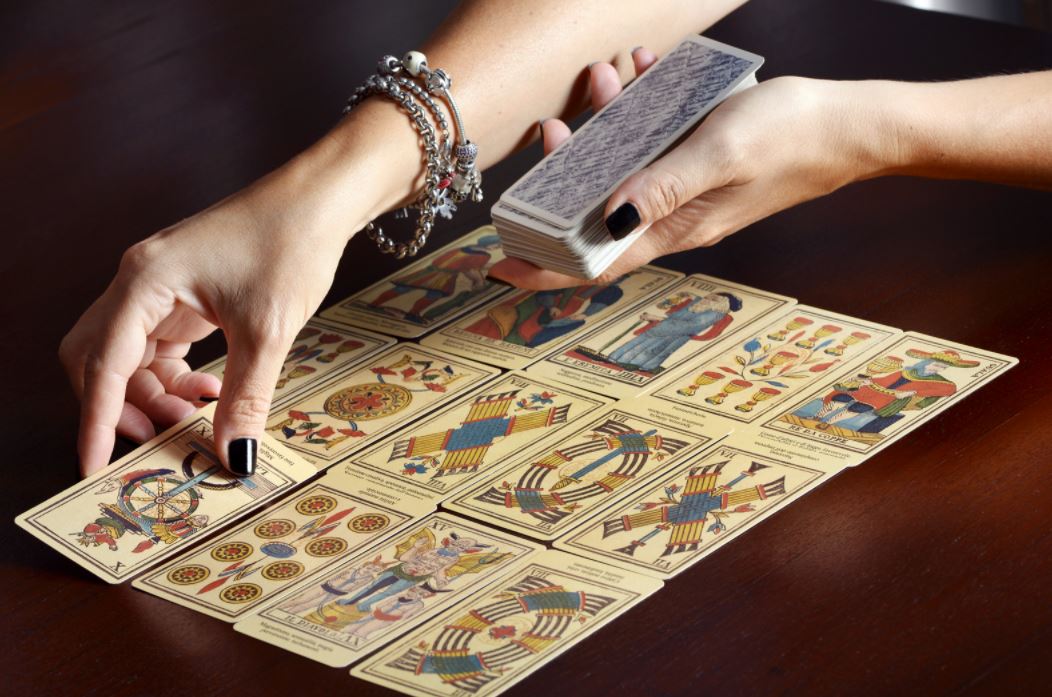
Tarot card symbol meanings are not a single fixed code. A picture may draw on art, religion, mythology, everyday objects, the deck creator’s culture, and the reader’s personal associations. The same symbol can support several interpretations depending on the question, the surrounding cards, and the artwork in that particular deck.
The Rider–Waite–Smith deck is a common learning deck because its illustrated scenes influenced many later designs. It is not the only valid system, and its imagery should not be projected onto decks that use different traditions. Treat symbols as prompts for reflection, not proof of hidden facts or a guaranteed forecast.
Begin with what is actually on the card
Before consulting a guidebook, describe the image without interpreting it. Who or what appears? Which direction are figures facing? What is repeated? Where is movement or stillness? Which colors dominate? What feels close, distant, protected, exposed, balanced, or unstable?
Then record your first association and compare it with the deck’s guidebook. This two-step method preserves personal response while keeping you anchored to the artist’s intended system. If you want a broader introduction to responsible use, see how tarot can support reflection.
Major Arcana: archetypal scenes
The 22 Major Arcana cards depict large themes such as beginnings, choice, change, responsibility, disruption, and integration. Their scenes draw from multiple European artistic and esoteric sources, so claims that every card directly comes from one mythology are usually too simple.
- Justice: In the Rider–Waite–Smith image, a seated figure holds scales and an upright sword. Readers often associate the scales with evaluation and balance, while the sword can suggest clarity, consequence, or a decisive judgment. The card does not guarantee a legal outcome.
- Death: A skeleton in armor rides a pale horse beneath a dark banner bearing a white rose. Figures respond in different ways as the sun appears between distant towers. Readers often use this scene to explore endings, transition, loss, and renewal; it does not literally predict a death.
- Strength: A calm figure gently holds a lion’s jaws beneath an infinity symbol. Common themes include patient courage, self-regulation, compassion, and working with instinct. The image is not a record of one universally agreed fable.
- The Magician: A figure raises a wand while pointing toward the earth; a cup, pentacle, sword, and wand rest on the table. The arrangement is often read as focused attention, available tools, initiative, and turning intention into action.
These are starting points, not verdicts. Ask which part of the scene best connects to the present question and what evidence in daily life supports that connection.
Minor Arcana: suits and everyday themes
The 56 Minor Arcana cards are commonly divided into four suits. In many modern systems, pentacles or coins are associated with earth and practical resources; cups with water and emotion; swords with air, thought, and communication; and wands with fire, drive, and creativity. Decks may rename or reinterpret the suits.
- Pentacles: work, money, health routines, material resources, and stewardship
- Cups: feelings, relationships, imagination, receptivity, and connection
- Swords: ideas, language, decisions, conflict, analysis, and boundaries
- Wands: energy, ambition, experimentation, desire, and initiative
A suit association should not override the image. A cup card can involve boundaries, and a sword card can involve emotion. Use the suit as one layer among several.
Numbers show patterns, not fixed events
Readers often compare the same number across all four suits. Aces may suggest a beginning or concentrated potential; twos may involve contrast, exchange, or choice; fives often depict disruption; tens can show completion, excess, or the consequence of a long process. Court cards may represent a person, a role, an approach, or a developmental stage.
Numerology varies among tarot traditions. Rather than memorizing “two always means partnership,” compare the actual cards. The Two of Cups depicts exchange and mutuality, while the Two of Swords emphasizes a guarded pause and the Two of Pentacles shows active balancing. The shared number creates a family resemblance, not an identical message.
Color, direction, and landscape
Color can shape mood, emphasis, and contrast, but a universal color dictionary is unreliable. Red can suggest vitality, warning, conflict, warmth, or ceremony depending on the context. Blue may feel calm in one image and cold or distant in another. Printing, restoration, and deck design also change color choices.
Direction offers another clue. A figure looking toward the left or right may appear to face the past or future in some reading systems, but this convention is not universal. Mountains can imply challenge or perspective; walls can suggest protection or restriction; water may evoke emotion, movement, purification, or uncertainty. Phrase interpretations as possibilities: “This wall could represent a boundary,” rather than “The wall means you are trapped.”
Build a meaning from layers
- State the question in an open, non-deterministic way.
- Describe the visible scene before naming a meaning.
- Identify the card’s suit, number, or Major Arcana role.
- Choose two or three possible symbolic themes.
- Compare those themes with the surrounding cards.
- Connect the reading to one practical, reversible action.
- Review later and count mismatches as well as apparent matches.
This method turns intuition into a transparent process. The reality-check approach in our clairsentience guide can also help you separate an observation from an interpretation.
Keep readings ethical and useful
Do not use a symbol to diagnose illness, declare pregnancy, accuse someone of cheating or a crime, guarantee money, or predict death. Ask permission before reading about another person’s private life. For major medical, legal, financial, or safety decisions, rely on qualified professionals and verifiable information.
Be cautious if a reader turns an alarming card into a demand for more money, a curse-removal ritual, or repeated urgent sessions. Review the warning signs in how to avoid psychic-reading scams. A responsible interpretation leaves you with options rather than fear or dependency.
A simple practice for one card
Draw one card and write four short lines: what you see, what it reminds you of, an alternative interpretation, and one action under your control. For Death, for example, you might notice the rising sun, associate it with a transition, consider that you may simply be reacting to the card’s title, and choose to finish one overdue task. This keeps symbolism connected to life without pretending the card controls the outcome.
Frequently asked questions
Do tarot symbols have one official meaning?
No. Guidebooks and traditions provide common associations, but meaning also depends on the deck, image, question, spread, and reader. Interpretations should be presented as possibilities rather than facts.
Does the Death card predict a literal death?
No. Readers commonly use it to reflect on endings, transition, or renewal. It should never be used to predict a person’s death or frighten someone into paying for additional services.
How should a beginner learn tarot symbols?
Describe the image first, compare it with the deck’s guidebook, track repeated motifs, list alternative meanings, and connect the reading to a practical and reversible action.
Can tarot symbols answer medical, legal, or financial questions?
They may prompt reflection, but they cannot establish facts or replace qualified advice. Use reliable evidence and appropriate professionals for consequential decisions.