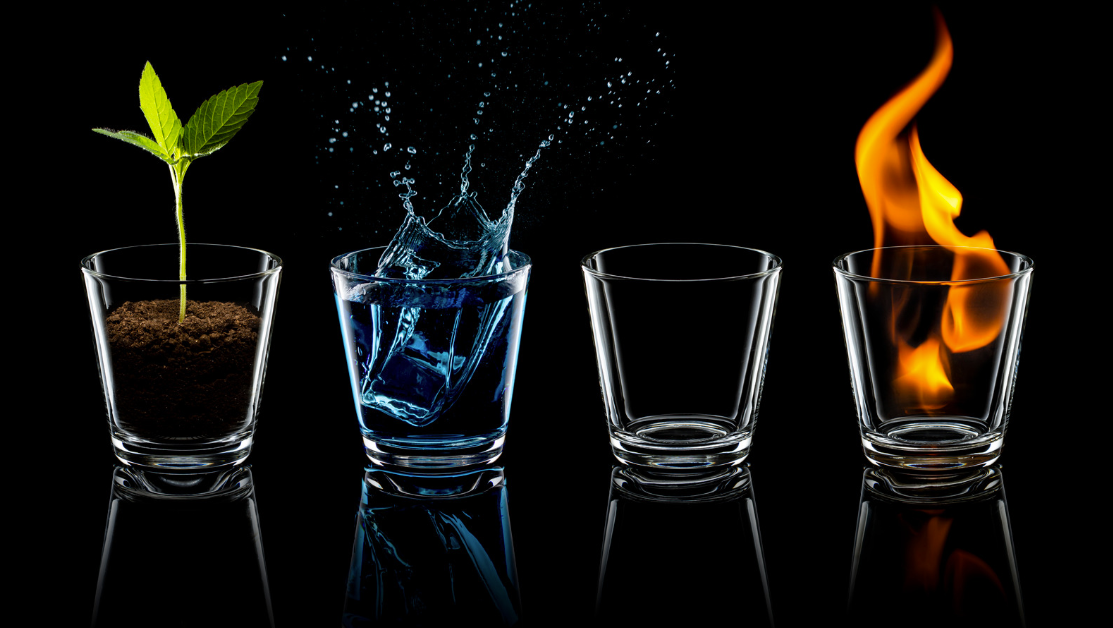
Earth, air, fire, and water have been used as symbols in philosophy, spirituality, art, and ritual for centuries. Some modern practices add spirit as a fifth element. These systems can provide a memorable way to reflect on stability, thought, motivation, emotion, and meaning—but they are symbolic frameworks, not scientific forces that diagnose or control your health, money, relationships, or future.
You can let the elements “guide” you by turning each symbol into a practical question and a small, safe action. You do not need to believe that an element literally enters your body or guarantees an outcome.
Quick guide to the five-element reflection
- Earth: What needs structure, maintenance, or a practical next step?
- Air: What needs perspective, learning, or clear communication?
- Fire: What needs energy, courage, limits, or a deliberate start?
- Water: What feeling needs acknowledgment, flexibility, or care?
- Spirit: What value, purpose, relationship, or larger meaning matters here?
Choose one question, write for five minutes, and identify one action you can complete today. The symbols are prompts; your observation and judgment remain in charge.
Where the four elements come from
There is no single universal element system. In ancient Greek philosophy, Empedocles developed an influential account of four “roots”—earth, air, fire, and water—moved by Love and Strife. The Stanford Encyclopedia of Philosophy places this in the middle of the fifth century BCE. Later traditions interpreted and rearranged these symbols in different ways.
Other cultures have their own systems, terms, histories, and religious meanings. Chinese wuxing, for example, is commonly translated through five phases or processes and should not be treated as a simple copy of the Greek four-element model. When borrowing from a living tradition, learn from credible sources and avoid presenting a personal adaptation as an ancient universal rule.
Modern occult correspondences—directions, colors, tarot suits, seasons, animals, or personality traits—also vary by school. A chart can be useful inside a particular practice, but it should not be presented as objective fact.
Earth: build stability
Earth can represent the material conditions that support daily life. Look at sleep, meals, housing, finances, schedules, medication routines, and the physical space around you. “Grounding” can be as ordinary as putting both feet on the floor, naming what you see, washing dishes, reviewing a bill, or taking a measured walk.
Try an earth check-in:
- Name the situation you want to stabilize.
- List what is within your control today.
- Choose a task that takes less than 20 minutes.
- Schedule a larger task or ask for appropriate help.
Stones, plants, soil, or a favorite object can serve as visual reminders, but they do not create wealth or treat illness. If you are using elemental imagery after an intense spiritual experience, the practical reset in Staying Grounded When Your Third Eye Opens may help.
Air: create space for thought and communication
Air can symbolize breath, ideas, language, and perspective. Use it to ask whether you have enough information, whether an assumption has been checked, and whether a conversation would help.
A gentle breathing practice may feel calming, but avoid prolonged breath-holding, forceful hyperventilation, or any exercise that makes you dizzy. If breathing is difficult or accompanied by chest pain, fainting, or another urgent symptom, seek medical care rather than interpreting it as an energetic shift.
For a simple air practice, open a window if conditions are safe, take several comfortable breaths without forcing them, then write one fact, one uncertainty, and one question you can ask. This turns “air” into clearer thinking rather than a promise of supernatural knowledge.
Fire: direct motivation safely
Fire can represent attention, transformation, courage, anger, or momentum. Instead of assuming low motivation means a deficient element, check ordinary causes such as exhaustion, stress, depression, pain, an unrealistic workload, or a task that lacks a clear first step.
Use a fire prompt: “What deserves energy, and what needs a boundary?” Set a timer for ten minutes and begin one concrete task. If anger is the dominant feeling, step away from conflict, cool your body, avoid sending messages impulsively, and return when you can communicate safely.
A candle is optional. If you use one, keep it in a stable holder on a clear, heat-resistant surface, away from children, pets, curtains, paper, and drafts. Never hold your hand over a flame, move a burning candle, or leave it unattended. The National Fire Protection Association’s candle-safety guidance emphasizes that candles can cause home fires and fire deaths. A battery candle works just as well as a symbolic focus.
Water: acknowledge emotion without diagnosing it
Water can symbolize feeling, change, rest, and adaptability. Sadness or crying does not mean you have “too much water energy.” Emotions can reflect loss, conflict, hormones, health conditions, stress, or many other factors. Let the symbol prompt care without replacing a real assessment.
Ask: “What am I feeling, what may have contributed to it, and what support would help?” Drink water according to normal thirst and health guidance; excessive water intake is not a spiritual cleanse and can be harmful. A shower, cup of tea, or time near water may feel soothing, but none is a guaranteed healing treatment.
If sadness, anxiety, irritability, or loss of interest persists or interferes with daily life, contact a qualified health professional. Elemental practice can accompany appropriate care, not replace it.
Spirit: connect action to values
Some traditions use spirit, ether, or quintessence as a fifth element; others do not. In a personal practice, spirit can stand for meaning, conscience, community, faith, or the connection among the other prompts.
Ask: “Which value do I want my next action to express?” The answer might be honesty, patience, courage, compassion, stewardship, or rest. Then choose behavior another person could observe. A value becomes useful when it informs action, not when it is used to claim superior spiritual status.
If you are building a new practice, this beginner’s guide to a spiritual journey offers a grounded way to start without chasing dramatic experiences.
A safe five-element ritual
This ten-minute exercise uses ordinary objects and no open flame:
- Place a stone or household object nearby for earth.
- Notice a comfortable natural breath for air.
- Switch on a lamp or battery candle for fire.
- Set down a normal glass of water for water.
- Write one value on paper for spirit.
- Review the five prompts and choose one present-day action.
Do not ingest herbs, oils, ash, soil, or ritual substances. Do not burn materials indoors unless they are designed for that use and you have adequate ventilation and fire precautions. Adapt the exercise for disability, allergies, religious boundaries, weather, and household safety.
Working with nature without turning it into treatment
Time outdoors can support movement, attention, and a sense of connection. It does not automatically “balance” a person or cure low mood. Choose conditions appropriate to your body and local environment, check air quality and weather, and carry needed medication or mobility support.
Sun exposure is not a treatment for missing fire energy. The Centers for Disease Control and Prevention warns that excess ultraviolet exposure can harm skin and eyes and recommends shade, protective clothing, sunglasses, and sunscreen. Avoid staring at the sun, intentional burning, or staying outside through heat or cold warning signs.
Keep the practice honest
After a week, review what changed. Did the prompts clarify a decision, help you start a task, or remind you to rest? Those are useful outcomes. Avoid claiming the ritual caused an unrelated event simply because it happened afterward.
Be cautious with anyone who says your elements are dangerously blocked, guarantees love or money after a ritual, diagnoses illness from a chart, pressures you to stop treatment, or demands escalating fees for cleansing. A credible spiritual guide allows uncertainty, respects consent, and does not isolate you from other support.
For a broader check on exaggerated promises, review spiritual advice and practices to avoid.
Frequently asked questions
Are there four elements or five?
Ancient Greek philosophy is strongly associated with earth, air, fire, and water. Some later spiritual systems add spirit or ether as a fifth element, while other cultures use different frameworks. No single list is universal.
Can elemental rituals heal a medical or mental health condition?
No elemental ritual is a proven replacement for medical or mental health care. Symbolic practices may support reflection or comfort, but persistent, severe, or worsening symptoms should be evaluated by a qualified professional.
Do I need a candle for a fire ritual?
No. A lamp, battery candle, warm color, or written intention can symbolize fire without an open flame. If you use a candle, keep it stable, attended, and away from anything that can burn.
What does being out of balance mean?
In an elemental practice, “out of balance” is best treated as a metaphor for an area needing attention. It is not a diagnosis. Check practical factors such as sleep, stress, health, workload, relationships, and support.
How can I use the elements in daily life?
Use each element as a question: earth for practical stability, air for information, fire for motivation and boundaries, water for emotion and flexibility, and spirit for values. Choose one small, observable action from your answers.