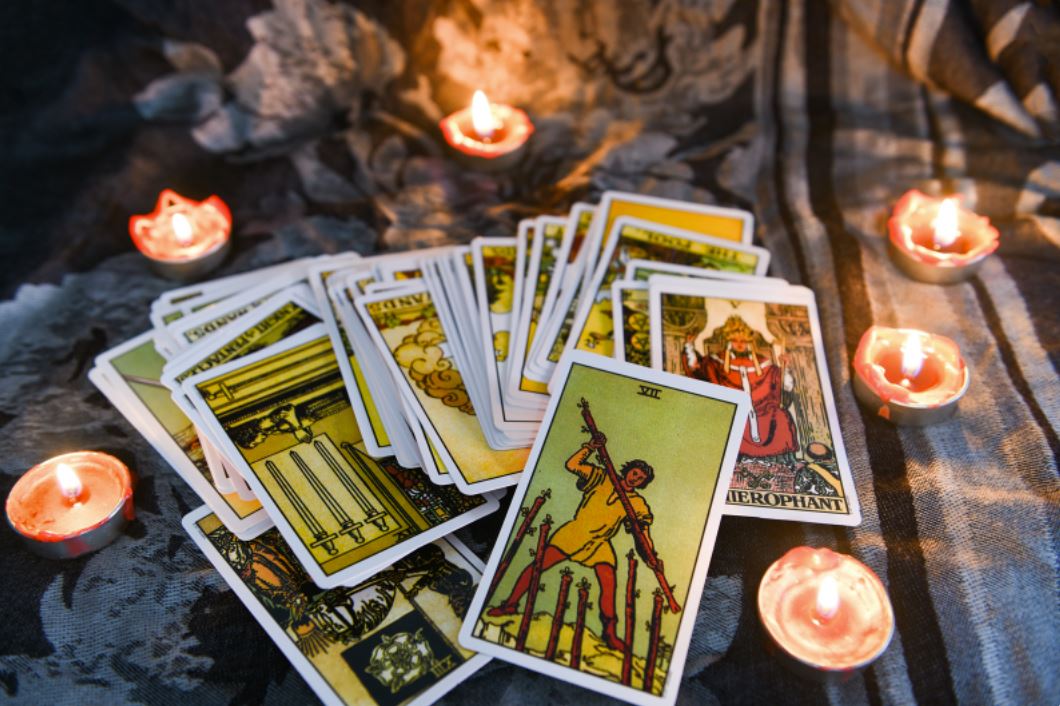
Tarot cards can help you slow down, name what you are feeling, and look at a question from more than one angle. They are not a scientifically validated way to predict a fixed future, diagnose trauma, read another person’s private thoughts, or guarantee an outcome. Used carefully, a reading is best treated as a structured reflection exercise: the images prompt associations, the reader asks questions, and you decide what fits the facts of your life.
Tarot in brief
Tarot developed from European card games and was later adapted for divination. A modern deck usually has 78 cards: 22 Major Arcana cards and 56 Minor Arcana cards. The Minor Arcana are divided into four suits, although their names and artwork vary by deck. Court cards commonly include a page, knight, queen, and king.
The Major Arcana often depict broad themes such as change, choice, disruption, hope, or completion. The Minor Arcana tend to focus on everyday experiences, relationships, work, conflict, emotion, and practical life. Our guide to tarot card symbols and meanings explains how imagery can support reflection without turning a symbol into a universal fact.
What a tarot reading can reasonably do
- Clarify a question: turning a vague worry into a specific decision you can examine.
- Surface assumptions: noticing the story you immediately attach to an image.
- Generate options: considering a response you had not previously named.
- Explore values: identifying what matters most and where your actions do not yet match it.
- Prepare for uncertainty: thinking through several plausible scenarios instead of demanding one prediction.
A useful insight should remain open to evidence. If a card seems to suggest conflict, ask what observable behavior supports that interpretation and what else could explain the situation. A dramatic image is not proof of betrayal, danger, pregnancy, illness, a curse, or another person’s intentions.
Ask questions that keep you in control
Open questions generally produce more useful reflection than yes-or-no predictions. Compare “Will I get the job?” with “What can I improve before the interview?” The second question leads to choices you can make even when the employer’s decision remains uncertain.
Try prompts such as:
- What part of this situation am I overlooking?
- What is within my control this week?
- What evidence would change my mind?
- Which boundary or conversation needs attention?
- What are the likely costs of each option?
- Who has relevant expertise I should consult?
Questions about another person should respect consent. Instead of asking whether a named person secretly loves you, ask what reciprocal interest looks like or how to communicate once and accept the answer. Tarot cannot override consent or establish facts that only the other person can confirm.
A simple three-card reflection
Shuffle in any way that feels comfortable and place three cards from left to right. Before reading a guidebook, write one sentence about what you notice in each image. Then use these positions:
- Context: What past event or current condition shapes the question?
- Choice: What attitude, action, or boundary deserves attention now?
- Next step: What small, ethical action could provide useful information?
This is not proof that the third card shows what will happen. It is a prompt for planning. For a decision, you can also assign positions such as option A, option B, and information still missing. Write the practical advantages, risks, and unknowns beside the symbolic impressions.
How to interpret without forcing an answer
Start with the artwork: people, posture, direction, color, objects, setting, and emotional tone. Add the deck creator’s intended meaning, then compare both with the question. A reversed card may be read as blocked, internal, delayed, or simply given the same meaning as upright; there is no single rule that every reader must use.
Avoid searching until you find the interpretation you want. Record the first reasonable reading, list an alternative, and check both against observable facts. Our article on approaching future-focused questions responsibly shows how scenarios and preparation are more useful than certainty.
Tarot and emotional wellbeing
A reading may help you describe feelings, but it cannot recover objectively accurate hidden memories or diagnose the cause of trauma. Memory is reconstructive, and leading interpretations can create false confidence. If trauma, panic, depression, grief, self-harm, or abuse is affecting daily life, a licensed mental-health professional or appropriate support service is a better source of care.
Pause a reading if it increases fear, compulsion, or dependence. Repeatedly drawing cards until anxiety drops can strengthen a reassurance cycle. Set a limit—perhaps one spread and one written action—then return to ordinary evidence and daily life.
Choosing a reader safely
A responsible reader explains the format, fees, time limit, and privacy practices; accepts disagreement; avoids guaranteed predictions; and encourages your autonomy. The reading should not replace medical, legal, financial, or mental-health advice. A thoughtful session can be meaningful, but its value comes from reflection and conversation rather than supernatural certainty. See how to evaluate a psychic reading before booking.
Leave if someone claims you are cursed, demands additional payment to remove danger, guarantees a soulmate or investment return, tells you to stop treatment, requests passwords or verification codes, or pressures you to keep the reading secret. Never send gift cards, cryptocurrency, wire transfers, or intimate images in response to fear-based claims.
After the reading
Write down the question, cards, interpretation, alternative explanation, and one action. Review the notes later rather than judging accuracy from a memorable coincidence. Ask whether the reading helped you make a safer, kinder, or better-informed choice. If not, it is reasonable to discard the interpretation.
Frequently asked questions
Can tarot cards predict the future?
Tarot is not a scientifically validated method for predicting fixed events. It can help you explore possibilities and prepare for uncertainty, but outcomes depend on actions, circumstances, and other people’s choices.
Do I need psychic ability to read tarot?
No. You can use the imagery, a guidebook, and reflective questions. Treat interpretations as prompts to examine, not facts you must believe.
Can tarot uncover the cause of trauma?
Tarot cannot verify hidden memories or diagnose trauma. It may help you name feelings, but trauma concerns should be handled with qualified mental-health support and evidence-based care.
How often should I ask the same question?
Avoid repeated draws for reassurance. Use one reading to identify an action or information gap, then allow time for evidence before revisiting the question.