People Are Going Outside to Feel Like Themselves
People have been searching for calmness for years, but the way that they’re approaching it is changing. After years of dealing with digital alerts, screens, and emotional saturation, more people are going outside not to exercise or for productivity, but just to feel like themselves. Even environmental psychologists have been documenting the change, saying how the nervous system responds almost instantly when a person goes into natural environments. Even Harvard Health reports that spending time in nature can lower the stress hormone and improve mood in ways that doing activities inside can’t compare.
But beyond research, there’s something that’s more intuitive that’s going on. Some people talk about going into nature as a way to reset, which is a place where their thoughts feel less stressful, and their emotions are able to be settled. Even intuitively say see clients to reconnect with their inner signals easier when they spend time around water, in the sun, around trees, or even in their garden. This isn’t just a mystical idea, but it’s an observation that when the noise gets quiet, people are able to hear themselves more clearly.
Since our world is overwhelmed by digital, it has made these moments in nature essential for our well-being. Even the pandemic helped to make this shift happen and made outdoor spaces feel like sanctuaries. People started going to trails, waterfronts, and even parks to help change their internal patterns. Even going out five minutes a day can make their hard days seem easier. This isn’t just a trend, but it’s a cultural turning point that shows that nature-based stress relief is becoming a standard part of emotional hygiene.
What Science Says About Nature and the Nervous System
Science has been studying nature-based stress relief for a long time. Researchers are starting to understand that nature doesn’t just make people feel calm, but it changes the nervous system into a regulated state in a way that’s measurable.
According to the American Psychological Association, it says that when people go out into nature, they have lower cortisol levels, less stress, and better cognitive functioning. Scientists at the University of Michigan even found that going outside for 20 minutes can boost the nervous system dramatically and can help the body recover faster from stress.
One of the most interesting research ideas comes in the study of forest bathing. This was first popular in Japan, and people who went into guided nature retreats had a decrease in rumination, which is a mental loop that is tied to depression and stress. According to the Cleveland Clinic, an immersive outdoor experience can increase heart rate variability, which is a key point in emotional resilience.
When you look from a different point of view, these findings can explain why nature is starting to be a baseline therapy for anxiety. There’s also a cultural change where people are saying that nature feels like an energy stabilizer. Even though psychics say this is the aura settling, psychologists say that it’s sensory regulation. Even though the languages sound different, they are saying the same thing that the system relaxes when the environment doesn’t demand anything from you.
Science and intuition are working together to show nature as important across all cultures and belief systems. Whether you trust data or just listen to your instincts, this research shows that nature can help to soften your stress levels in ways that modern life doesn’t often do.
How Nature Helps to Get Rid of Stress That Other Things Cannot

A lot of people try to relax by using meditation apps, breathwork videos, or a trip to the gym. Those tools can definitely help. But being in nature often feels different, almost deeper, like your whole system finally gets to breathe.
That’s because outside, all of your senses are working together. Your eyes take in real sunlight. Your ears hear wind, birds, or quiet background noise that isn’t a machine. Your skin feels the temperature shift. Even the air you breathe changes the way your body feels. Everything around you are real and alive.
Psychologists say this creates a kind of full-body calm. You’re not just thinking about relaxing, but your entire nervous system gets the message at once. Compare that to staring at a phone while using a meditation app. It can help you focus, but you’re still stuck in the same environment that stressed you out in the first place.
Some people are now trading scrolling for short nature breaks. A group of coworkers in Seattle started doing a tiny loop through nearby trees during lunch. They say they get fewer afternoon crashes and clearer thinking. College students report that stepping outside for even five minutes after studying feels like a weight lifted off their shoulders.
Researchers are calling this ambient attention. Instead of forcing yourself to concentrate like in traditional meditation, your awareness gently opens up. You notice the breeze, a bird passing by, or the way light moves. You aren’t trying to relax, but it just happens.
People who rely on intuition say this is when insights come more easily. When your mind isn’t working so hard, your inner clarity finally has room to show up. You don’t have to think your way into peace, but nature gives it to you.
That’s why time outdoors feels so refreshing. You don’t have to perform wellness or “try to be calm.” You simply settle into it.
How Nature Feels Like Being Home
Nature doesn’t just relax us, but it also feels familiar. Even if we live in cities now, our bodies were built outside. For most of human history, forests, rivers, open skies, and fresh air shaped how we handled stress and safety. Modern life, like screens, deadlines, buildings, and other things, is brand new by comparison. So when we step outside for a moment of relief, it isn’t a luxury. It’s a homecoming.
This can explain why there are many people who feel calmer when they go outside without even trying. Our bodies are able to look at natural environments as a high stability in a low-threat environment. With these patterns it shows us that the leaves, the rhythm of the waves, and even the visuals outside show safety to the brain. According to National Geographic, there is a link between natural patterns and emotional regulations that show how these things shape and activate the brain’s calm circuits.
Another reason why nature is so important is that there are many people who are skeptical about wellness products, but they love going out and sitting under a tree. You don’t have to be a subscriber, download an app, do a routine, or even have special knowledge to go outside in nature. Nature isn’t trying to sell you anything; it just offers you a place to rest. This is why there are many people saying that they go outside to have emotional honesty, and they go to a place where they feel less like performing and more like themselves.
A financial analyst in Chicago would walk on the shoreline of the beach after work when he was overwhelmed. He found that when he was outside, he would be stressed about making decisions, but when he went to the water, he would feel calm. A teacher would spend fifteen minutes each day in her garden and felt like this caused her to have an emotional compass reset before going to start her day at school.
All across the world and throughout cultures, there have been traditions that have looked at nature as part of their emotional balance and intuitive practices, especially cultures that are rooted in Eastern philosophies and indigenous ideas. They would describe nature as part of their own energetic field. Even psychics today say that going out in nature isn’t about mysticism, but it’s an intersection between psychology, ecology, and personal intuition.
Going into nature isn’t about nostalgia, but it’s about physiology, and people are moving towards what their minds and bodies remember.
How Nature Increases and Develops Intuition and Why People Are Turning There
People are turning to nature-based stress relief, not just to calm down, but also to help them tune in. There are many people who have talked about spending time outdoors to develop their intuition, to help them make better decisions, and to increase their internal alignment. This isn’t just a mystical claim, but it’s a psychological pattern.
Research shows that nature helps to lessen the cognitive load. When the brain isn’t dealing with crowded visuals, notifications, or never-ending multitasking, it allows for interception, which is the ability to feel internal cues. According to Stanford Medicine, quiet, low-stimulating environments help to improve problem-solving skills and give insight. This means that you think better when your mind is relaxed and has time to rest.
Going out in nature encourages this mental space. Some people talk about experiencing a moment when they’re walking in a trail, sitting by water, or looking at the horizon, where something clicks. This is an environment that is distraction-free and allows people to have thoughts that often get buried by indoor stress.
From a psychic’s perspective, this makes sense, and they often say that intuition gets stronger in stillness. They talk about nature as being able to clear background noise, and subtle cues become more recognizable. Some psychics call this energetic decluttering, and others call it tuning into rhythms that the body mirrors in its natural state.
One college student was having a hard time making a transfer decision, and she started taking evening walks along the river. She talked about how going outdoors helped her to hear the answer that she already knew was there. One remote worker would go outside regularly when having stressful workdays and would come back with clarity that was unexpected about what to do in the next project.
These times out in nature aren’t about predicting the future but about seeing and hearing yourself more clearly. In a culture where people often feel disconnected from their inner voice, this subtle sharpening of their intuition helped to give them a good reason to choose nature-based rituals over digital or indoor rituals.
Real-Life Examples of Rituals Outside That Reduce Stress

Nature-based stress relief is expanding quickly because people can feel the difference almost instantly, especially when the ritual is simple enough to repeat daily. The most convincing evidence doesn’t always come from lab studies but from real lives quietly transforming through small, consistent moments outdoors.
One example comes from a software engineer in Portland who created her own ritual called sunset decompression walks. As soon as she closes her laptop at 5 p.m., she heads out for a short loop around her neighborhood. She says watching the sky change color feels like her brain is changing state with it, and the tension built up from the workday dissolves within twenty minutes of walking.
A college student practices something she calls river rewiring. During intense exam weeks, she takes a notebook to a nearby riverbank and writes three quick sentences: what’s stressing her out, what she can actually control, and what she’s symbolically letting the water carry away. The combination of physical environment and mental clarity turns worry into motion rather than rumination.
A mother of two found her own version of stress relief through micro-forest breaks. She doesn’t have the time for long hikes, so she uses a cluster of trees behind her apartment building as a five-minute sanctuary. She places her hand on the tree bark and breathes slowly until her body loosens. She describes the trees as “co-regulators,” a term that rarely gets associated with indoor wellness tools but makes perfect sense outdoors.
Even those without access to large green spaces are adapting. A remote worker in New York practices balcony grounding with a small collection of potted plants. She laughs that her plants provide “better emotional feedback than most productivity apps,” but she’s noticed a very real change: when she’s caring for something alive, her stress loses the power to snowball.
Together, these examples show why outdoor rituals are quietly becoming the new wellness trend. They are:
- Simple.
• Accessible.
• Emotionally and physiologically effective.
• Supportive of intuitive clarity.
No complicated programs. No screens required. Just a brief step outside — and the nervous system remembers how to rest.
Why Micro-Nature Rituals Are Growing
Most people don’t have time for a weekend escape and maybe not even a long hike, and this is why micro nature rituals are becoming more popular. These rituals can take 5-10 minutes and can fit into commutes, workdays, apartments, or even in your car, but they still help with stress relief. They’re low-pressure, easy, and grounded in research.
According to the Cleveland Clinic, it says that having even small contact with natural environments can lower the stress hormone in the body, relax muscles, and reset a person’s emotional tone. This is part of the reason that micro nature times have become popular on TikTok and Instagram, where creators show small clips of grounding breaks, outdoor breathwork, and even morning light resets.
One technique is called sensory anchoring, and instead of trying to meditate and clear the mind, this is a natural sense that grounds you. Here’s how:
- Sound anchoring, which means focusing on sounds like birds chirping, wind blowing, and leaves rustling.
- Visual anchoring, which means focusing on what you see, such as trees moving or clouds drifting.
- Touch anchoring, which focuses on what you feel like touching, such as the cold grass, bark that has texture, and putting your hands on a warm rock.
- Scent anchoring, which focuses on what you are smelling, like the smell of soil, rain, or seasonal air.
Even these small cues can shift the nervous system. Some people talk about it as an organic exhale, which is a small thing that takes away stress before it gets out of hand.
Biophilic design is also becoming part of workplace wellness. This allows employees to have natural light, water features, plants, and to make space in outdoor patios. Some companies are even encouraging workers to go outside for outdoor resets after long meetings. According to National Geographic, these design elements can mimic the natural ecosystem, and this promotes mental clarity.
Psychics and intuitives recommend similar practices, like reconnecting with simple sensory rhythms, to help get rid of mental clutter and strengthen their inner perceptions. This tells us that nature can give your mind enough quiet to be able to hear what it’s been trying to tell you all along.
Doing these micro-nature practices is becoming popular because they are easy and realistic. You don’t have to be on a wilderness trail to reset, but you can just look out a window, stand by a plant, or go outside for a moment. These bits of nature help people to reset, recalibrate, and have the rest of their day with a clear mind.
The Lifestyle Change of Nature-Based Stress Relief
What began as a coping tool is turning into a cultural recalibration. Nature-based stress relief is no longer something people try only during overwhelming days, but it is steadily becoming a way of life. One major reason is accessibility. Nature doesn’t require subscriptions, equipment, or apps. It is free, familiar, and simple to use and is a refreshing contrast to the commercialization of modern wellness.
People are also recognizing that the environments we choose play a major role in how stress forms and is released. When the nervous system is constantly absorbing artificial lighting, background noise, and nonstop notifications, calm becomes a moving target. Outdoor environments, on the other hand, actively support regulation: natural light balances circadian rhythms, wind provides sensory input, and greenery reduces stress responses.
Workplaces are beginning to reflect this shift. Companies are adding outdoor seating, implementing walking meetings, and incorporating indoor gardens. Research on biophilic design shows measurable benefits: better concentration, improved mood, and lower burnout among employees. Nature isn’t just a backdrop anymore, but it’s a tool for restoring focus and well-being.
Environmental awareness is another key influence. As climate conversations deepen, many people feel a growing desire to connect with nature not just recreationally, but emotionally. The outdoors is being reframed as a partner in personal health, not a distant getaway, but something woven into everyday routines.
Another reason this movement is lasting: nature blends effortlessly with existing wellness habits. People pair outdoor time with breathwork, mindful walking, intuitive journaling, or barefoot grounding. These rituals feel personal rather than prescribed, which makes them easier to maintain long-term.
For those who embrace intuitive experiences, the outdoors still carries a quiet sense of wonder. Many people report sudden clarity while hiking, gardening, or sitting by water — not mystical predictions, but grounded insight that emerges when the mind finally has room to breathe.
All of these influences point to the same conclusion: nature-based stress relief isn’t a passing trend. It’s a shift toward the kind of lifestyle our nervous systems have been waiting for.
Doing Your Own Nature-Based Rituals
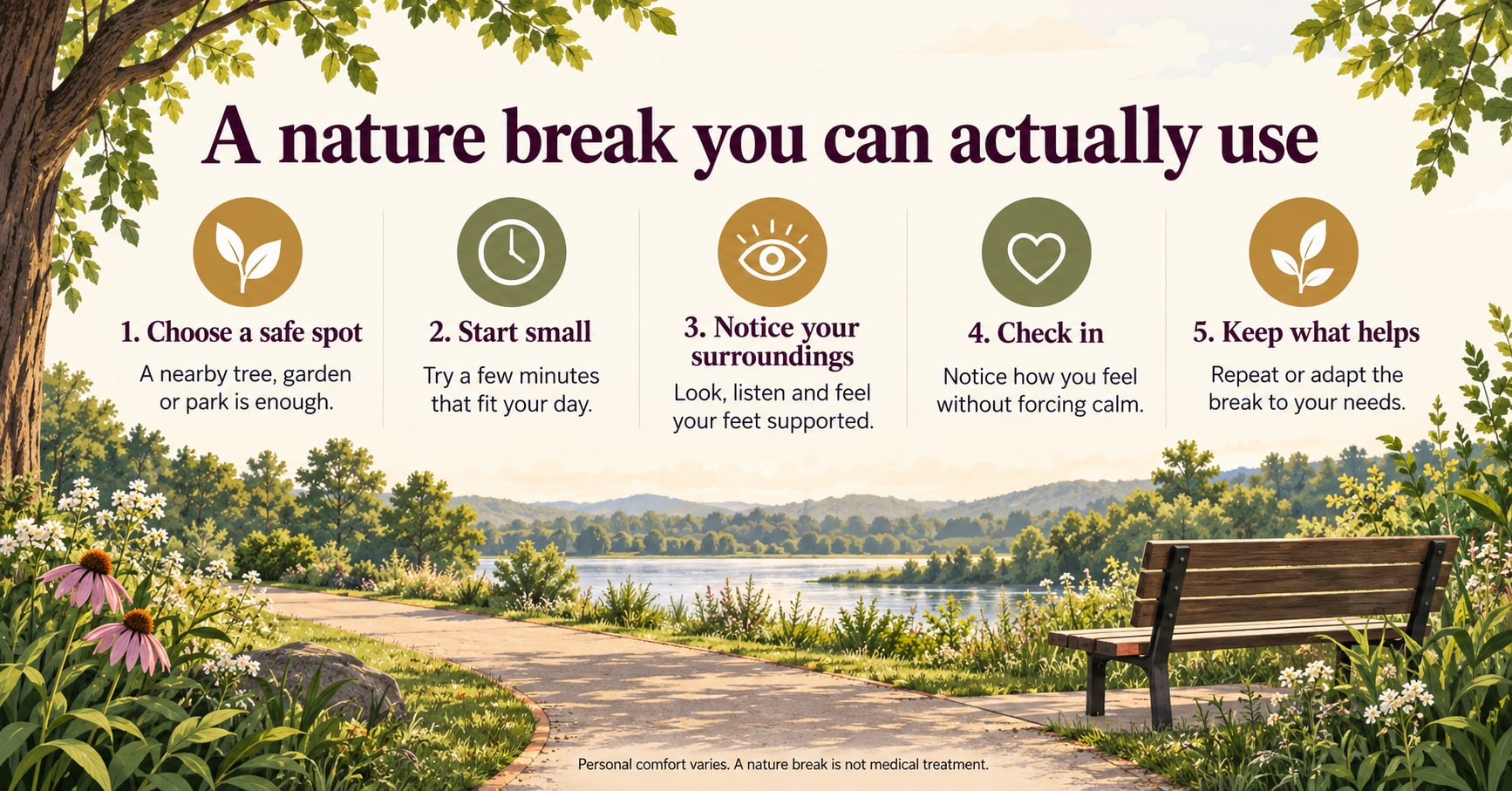
A nature-based stress relief routine doesn’t require travel, equipment, or major time commitments. In fact, the simpler the ritual, the more likely it is to become a habit. The goal is to build a steady relationship with the outdoors, whether you live near forests, sidewalks, or a skyline.
Start by noticing the natural elements already available to you: a small park, a row of street trees, a balcony garden, or even just the morning sky. What matters most is repetition. Five minutes daily is more beneficial than a longer session once a week, because the nervous system responds to consistent regulation.
Here’s a simple structure anyone can follow:
Step 1: Picking Your Natural Anchor
Pick one element to interact with regularly:
• Light.
• Airflow.
• Trees or plants.
• Water.
• Soil or grass.
This anchor becomes your grounding point each day.
Step 2: Using a Calming Action
This could be:
• Slow breathing.
• Gentle stretching.
• A short mindful walk.
• Simply placing your hand on a natural surface.
Small actions signal safety to the nervous system.
Step 3: Taking a Moment to Reflect
Ask one brief grounding question, such as:
• What do I need right now?
• What can I let go of today?
• What’s one doable step forward?
Psychologists call this micro-reframing. Intuitives call it clearing space for inner guidance. Both are correct.
Step 4: Using Sensory Imprint
Before heading back inside, notice one sensory detail:
• The feel of air on your skin.
• Color shifts in leaves or sky.
• A natural scent in the air.
This helps you “carry the calm” into whatever comes next.
If you want a slightly more intuitive variation, you can add a grounding phrase, try something simple like “Return to center” or “I’m safe to slow down.” These cues guide the mind without pressure or performance.
Another option is a “30-second sky break”: soften your gaze toward the horizon or the clouds. Wide-angle views reduce stress because the brain recognizes open space as safety. It’s effortless and surprisingly effective.
Nature-based rituals are adaptable, and they expand with your schedule instead of competing against it. Over time, your nervous system begins to expect these outdoor pauses, making it easier to access calm even during difficult moments.
Because when nature becomes part of daily life, stress doesn’t get the final word, but balance does.
Final Thoughts: Returning to Nature to Bring Calmness
Nature-based stress relief isn’t just a trend, but it’s a growing shift because it gives people something that modern life seems to take away: a feeling of coherence. The world around us is all about digital noise, cognitive demands, and social pressure, and going outside gives a time when nothing else is competing for your attention. This is a type of quiet that isn’t empty, but it’s about restoration.
Psychologists are confirming with their research what people who are psychic feel. This is why natural environments help to regulate and calm the nervous system, soften emotional reactions, and make mental clarity stronger and more accessible. Even beyond data, though, the truth is that people don’t just go into nature to escape but to be able to recognize themselves again.
For some people, these are moments that reveal something deeper. People talk about how, during walks, being by water or in their garden, they have an inner alignment. These experiences can reflect the brain’s ability to be able to process things more efficiently when they aren’t being overstimulated. This means that they are mirroring an interest in intuition as part of their emotional intelligence.
Whether you think that this means subtle energy, like neuroscience sees it, or as a psychic energy reset, the truth is that this can cause the body to soften, perspectives to get wider, and the mind to be quieter. People will feel more tuned in, grounded, and able to handle the situations in their lives better.
This is why nature-based stress relief is less about a trend and more about a necessity. This helps people to reconnect with the rhythm of their bodies, gives space for mental clarity, and gives the relationship a calmness that doesn’t need technology, tools, or trends, but just a few minutes to go outside and to listen.

‘Nature-based stress relief’ feels like the best-kept secret! I’ve been taking my lunch breaks at the park lately, and wow, what a difference! It’s amazing how just a few minutes outdoors changes everything!
‘Micro-nature rituals’? Sounds fancy! But honestly, who has time for that with life being so busy? A quick break outside could be beneficial though; I’ll give it a try—maybe during my coffee breaks!
This article highlights significant findings about nature and stress relief. The concept of ‘forest bathing’ is particularly fascinating and backed by research. It’s interesting how our ancestors instinctively knew the benefits of nature long before studies confirmed it.
Can we all agree that being told to go outside feels like being told to ‘just relax’? It’s like saying ‘don’t think about elephants’—what do you think about? Elephants! 😂 But hey, maybe I should try it anyway!
What a refreshing read! It’s so true that stepping outside can instantly lift your mood. Nature really does have a magical way of calming the mind. I’ve started taking short walks, and I can already feel the difference! 🌳😊
While this sounds nice in theory, it’s hard to believe that just going outside can fix all our problems. Life is complicated, and a stroll in the park isn’t going to change that. Maybe we need more than just fresh air.
‘Ambient attention’ sounds intriguing! I’ve noticed that when I’m outside, my mind clears up too. It seems like spending time outdoors isn’t just relaxing but might also enhance our creativity. Definitely worth exploring!
Isn’t it ironic how we need studies to prove something as basic as being in nature helps us? We’ve been doing this for ages! Sure, it’s nice that science supports it now, but people should have always known how calming nature can be.
‘Science confirms what we already knew’ is such a cliché at this point. If people really understood this before, why do they still rely on apps and screens for relaxation? Seems contradictory.
‘Nature therapy’—sounds like something they’d sell in a bottle next! Just add some glitter and charge $29.99 for it, right? 😂 Who knew stepping outside could be so trendy?