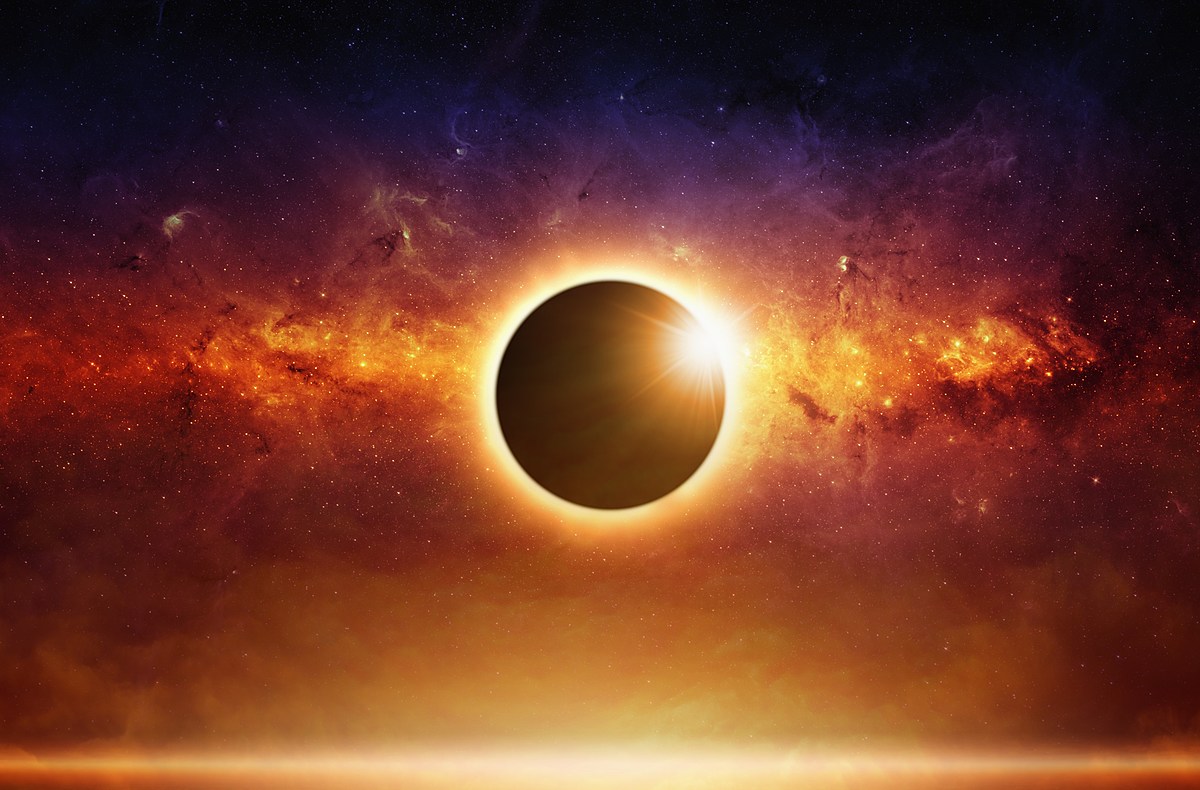
A solar eclipse is a real astronomical event that happens when the Moon passes between the Sun and Earth, blocking some or all of the Sun for observers in part of the world. In astrology, the same event is often treated as a symbol of beginnings, interruptions, or a change in perspective. Those meanings belong to an interpretive tradition; there is no scientific evidence that an eclipse determines a person’s future or causes specific life events.
What Actually Happens During a Solar Eclipse?
Solar eclipses occur only around a new moon, when the Sun, Moon, and Earth align closely enough for the Moon’s shadow to fall on Earth. The alignment can produce a total, partial, annular, or hybrid eclipse. Because the Moon’s orbit is tilted relative to Earth’s orbit around the Sun, an eclipse does not happen at every new moon. NASA’s guide to eclipse geometry explains the observable mechanics and the different shadows involved.
The astronomical event can be predicted with precision. Its astrological meaning cannot be tested or predicted in the same way. Keeping those two ideas separate makes it possible to enjoy symbolism without confusing it with physical cause and effect.
What a Solar Eclipse Can Symbolize in Astrology
Many astrologers read a solar eclipse as an intensified new moon: a symbolic moment for noticing what is beginning, what has been obscured, or where a familiar pattern may need review. Common themes include identity, direction, visibility, priorities, and the tension between acting quickly and waiting for clearer information.
An astrologer may also consider the zodiac sign of the eclipse, the chart house where it falls, its aspects to natal planets, and its relationship to the lunar nodes. Different schools interpret these factors differently, so two responsible readers may reach different conclusions. A chart reading is best treated as a reflective framework, not a guaranteed forecast.
A Grounded Way to Reflect on an Eclipse
If eclipse symbolism feels meaningful to you, use it to generate questions rather than certainties. Write down the interpretation you are considering, then separate it into three parts: what you directly observed, what you inferred, and what action is within your control.
- Observe: What is actually changing in your schedule, relationships, work, or emotional state?
- Interpret: What story are you attaching to that change, and what other explanation could fit?
- Act: What small, reversible step would help even if the astrological interpretation is wrong?
This approach leaves room for intuition while protecting your judgment. If you want to strengthen that balance, see our guide to increasing your intuitive giftings. You can also explore how symbolic systems are interpreted in our overview of Tarot card symbol meanings.
What Not to Assume
A solar eclipse is not evidence that a breakup, job loss, illness, financial windfall, or spiritual awakening is destined to happen. Strong feelings during an eclipse can be real, but they may also reflect expectation, stress, disrupted routines, or confirmation bias. Avoid making irreversible decisions solely because a chart or reader describes the period as fated.
For medical, legal, financial, or safety decisions, rely on qualified professionals and verifiable information. Astrology may help you name a concern or clarify a value, but it should not replace expert advice. If you choose an intention for the period, connect it to a practical next step; our article on manifesting with power explains how to turn reflection into realistic action.
How to View a Solar Eclipse Safely
Never look directly at the Sun without proper protection. Except during the brief total phase of a total solar eclipse, NASA advises using safe solar-viewing glasses or an indirect method such as a pinhole projector. Ordinary sunglasses are not safe. During a partial or annular eclipse, proper eye protection is required throughout the event. Review NASA’s current solar eclipse safety guidance before viewing.
Frequently Asked Questions
Is a solar eclipse bad luck?
No scientific evidence shows that a solar eclipse causes bad luck. Some traditions attach warnings or symbolic meanings to eclipses, but those beliefs vary by culture and should not be treated as proven predictions.
Can a solar eclipse cause major life changes?
There is no scientific evidence that an eclipse causes personal events. You may use it as a symbolic prompt to review goals or patterns, while basing decisions on circumstances, evidence, and actions you can control.
Can I look directly at a solar eclipse?
Not without proper protection. Use compliant solar-viewing glasses or a safe indirect viewing method, and follow current NASA guidance. Regular sunglasses do not provide adequate protection.
How long does a solar eclipse influence astrology?
Astrological schools give different answers, ranging from days to months, but no measurable duration has been scientifically verified. Treat any proposed timeline as part of an interpretive tradition rather than a deadline or certainty.