

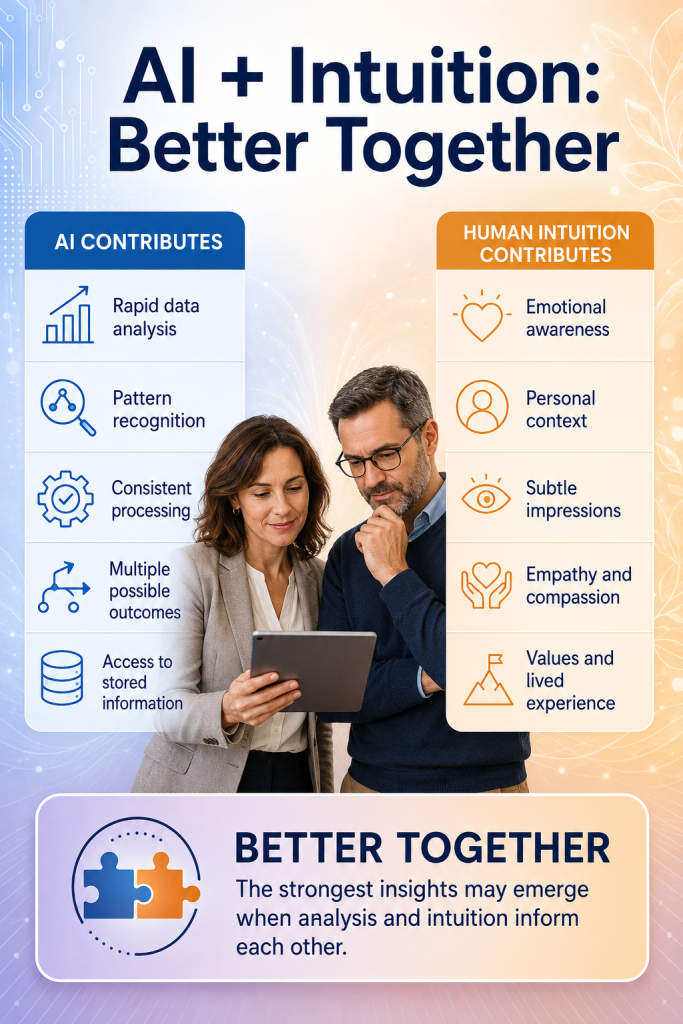
Artificial intelligence and human intuition can work together effectively when each is given a clear role. AI can summarize information, calculate, compare options, and surface patterns. A person must still define the goal, check the inputs, judge context, weigh values, and take responsibility for the decision.
Neither side is automatically reliable. An AI system can produce fluent but false output, inherit bias, miss recent or private context, or optimize the wrong target. Intuition can reflect genuine expertise, but it can also be shaped by fatigue, fear, wishful thinking, stereotypes, and selective memory. The useful question is not “AI or intuition?” It is “What combination of evidence, tools, review, and accountability fits this decision?”
What Human Intuition Is
Intuition is a rapid judgment that arrives without a fully conscious chain of reasoning. In familiar environments, an experienced person may recognize patterns before they can explain every cue. A nurse may notice that a patient looks subtly different; an editor may sense that a paragraph is unclear; a mechanic may recognize an unusual sound.
Intuition tends to be more trustworthy when the person has repeated experience, receives timely feedback, and works in an environment with reasonably stable patterns. It is less dependable when outcomes are rare, feedback is delayed, incentives are distorted, or emotions are intense. A gut feeling should start an investigation, not end one.
What AI Contributes
Different AI systems do different jobs. A forecasting model estimates probabilities from structured data. A classifier assigns categories. A recommendation system ranks options. A generative model produces text, images, code, or summaries based on patterns learned from data and the information supplied at use time.
AI can be especially helpful for:
- Comparing more records than a person can review manually.
- Applying the same calculation repeatedly.
- Finding anomalies that deserve human attention.
- Creating a first draft, checklist, or set of alternatives.
- Showing how an answer changes when assumptions change.
These advantages do not mean the system understands a situation as a person does. Output quality depends on the model, data, instructions, integrations, and evaluation process.
Why “AI Versus Humans” Is the Wrong Frame
Most real workflows are already combinations of people, software, policies, and data. The important design choice is where automation ends and accountable human judgment begins. The U.S. National Institute of Standards and Technology’s AI Risk Management Framework treats AI as a socio-technical system and emphasizes governance, measurement, transparency, privacy, fairness, safety, and reliability across its lifecycle.
Human review is not useful merely because a person clicks “approve.” The reviewer needs enough time, authority, information, and expertise to challenge the system. If staff are expected to accept hundreds of outputs quickly, the label “human in the loop” may conceal automation bias rather than control it.
A Practical Human-AI Decision Loop
- Frame the decision. State the goal, affected people, time horizon, and what success and harm would look like.
- Gather evidence. Identify the data source, age, missing fields, uncertainty, and information the system cannot see.
- Ask AI for structured help. Request alternatives, assumptions, counterarguments, or calculations—not just one confident answer.
- Verify important claims. Check primary sources, calculations, dates, names, and citations independently.
- Use intuition diagnostically. If something feels wrong, name the cue and investigate it. Do not treat the feeling as proof.
- Apply values and context. Consider consent, fairness, privacy, relationships, and consequences that may not appear in the data.
- Decide and document. Record who decided, what evidence was used, and why the choice was reasonable.
- Monitor the outcome. Look for errors, uneven impacts, complaints, and changed conditions; revise when needed.
Use AI to Expand Options, Not Manufacture Certainty
Generative AI is useful for brainstorming, but plausible language can hide weak assumptions. Ask it to list what information is missing, describe opposing interpretations, and separate facts from suggestions. Require links to sources, then open those sources rather than trusting a citation-shaped answer.
For personal decisions, AI can help create a comparison table or questions for a conversation. It cannot know another person’s private thoughts, guarantee a relationship outcome, or determine what your intuition “really means.” Our guide to grounded inner wisdom explains how to turn a feeling into a question you can examine.
Match Oversight to the Stakes
A low-stakes task such as drafting a packing list may need only a quick review. A high-stakes task involving health, employment, credit, housing, education, legal rights, safety, or large financial consequences needs qualified oversight, tested systems, documented controls, a way to appeal, and compliance with applicable law.
Do not paste confidential medical records, legal documents, private messages, passwords, or customer data into a public AI service unless you have authorization and understand its data terms. Remove unnecessary identifiers and use an approved system for sensitive work.
Where Intuition Commonly Fails
People often overweight vivid stories, recent events, first impressions, and evidence that supports an existing belief. Confidence can rise without accuracy. Groups can reinforce the same mistaken assumption, especially when hierarchy discourages questions.
Use prewritten criteria, independent estimates, checklists, and a deliberate pause for consequential choices. Ask: “What evidence would change my mind?” and “What would I advise someone else with the same facts?” If spiritual practices are part of your process, our article on predictions and fair evaluation offers ways to record both matches and misses.
Where AI Commonly Fails
- False or invented output: a confident answer may contain fabricated details or sources.
- Data gaps: the system may lack recent, local, private, or minority-group information.
- Bias and uneven performance: averages can hide worse outcomes for particular groups.
- Proxy problems: a measurable variable may stand in poorly for the real goal.
- Privacy and security risks: prompts, files, and integrations may expose sensitive information.
- Automation bias: people may defer to a system even when they notice a warning sign.
- Model and workflow drift: performance can change as data, users, or system components change.
Test the exact workflow, not just the underlying model. NIST’s framework organizes ongoing risk work around governing, mapping, measuring, and managing rather than treating one launch-time test as permanent proof.
Examples of Responsible Collaboration
Writing and Research
Use AI to outline, identify missing questions, or simplify a draft. A human checks sources, removes invented claims, preserves voice, and decides what should be published.
Hiring
AI might organize applications, but people must validate job-related criteria, test for unequal effects, protect applicant data, provide appropriate notice, and preserve meaningful review. A manager’s “culture fit” intuition also needs scrutiny because it can encode similarity bias.
Healthcare
A validated tool may highlight an image or risk pattern. Qualified clinicians interpret it with symptoms, history, examination, patient preferences, and known limitations. A chatbot or intuition alone should not diagnose or determine treatment.
Finance
Software can model budgets or scenarios, but outputs depend on assumptions. Verify rates and fees, stress-test downside cases, and consult a qualified professional for decisions with serious consequences. Neither an algorithm nor a psychic impression can guarantee returns.
Relationships
AI can help draft questions or organize your thoughts. It cannot measure consent, read a partner’s mind, or replace a direct conversation. Look at consistent behavior and use our guide to communication and boundaries in relationships.
A Quick Review Checklist
- Is the task appropriate for AI, and what happens if it is wrong?
- Do we know the data source, limits, and date?
- Can a reviewer inspect and challenge the output?
- Have factual claims and calculations been independently checked?
- Are affected people protected from privacy, bias, and safety harms?
- Is there an alternative process and a way to correct or appeal a result?
- Are outcomes monitored after deployment?
- Is a named person accountable for the final decision?
Frequently Asked Questions
Can AI replace human intuition?
AI can automate parts of a task, but it does not remove the need to define goals, evaluate context, apply values, and assign accountability. Whether human review is required depends on the system and the stakes.
When is intuition most useful?
Intuition is most informative in a familiar environment where a person has relevant experience and receives reliable feedback. It should still be checked against evidence, especially when emotions or consequences are substantial.
How can I verify an AI answer?
Separate claims from suggestions, check names, dates, calculations, and quotations against primary sources, test important outputs, and ask what information is missing. Do not rely on confidence or polished wording.
Should AI be used for high-stakes decisions?
Only with controls appropriate to the domain, including qualified oversight, validation, privacy protection, bias evaluation, documentation, monitoring, and a meaningful way to challenge errors. Applicable professional and legal requirements still govern.