People naturally want to know what comes next. The honest answer is that no spiritual practice, psychic reading, chart, card spread, or numerical system can reliably guarantee a specific future. Some traditions can still be meaningful as cultural practices or tools for reflection, provided their limits are clear.
The most dependable forecasting combines current evidence, base rates, expert knowledge, and flexible plans. Spiritual methods can help you name hopes and fears, but they should not replace medical, legal, financial, or safety advice.
Prediction Is Not the Same as Planning
A prediction claims that an outcome will happen. A forecast estimates what is more or less likely under stated conditions. A plan identifies what you can do across several possible outcomes. Forecasts and plans can be updated when new information appears; certainty claims usually cannot.
For an important decision, write down:
- What you know from reliable evidence.
- What you are assuming.
- What remains unknown.
- The most likely, best-case, and worst-case scenarios.
- Which next step is useful in more than one scenario.
This approach does not eliminate uncertainty, but it can reduce avoidable risk.
Astrology as a Reflective Tradition
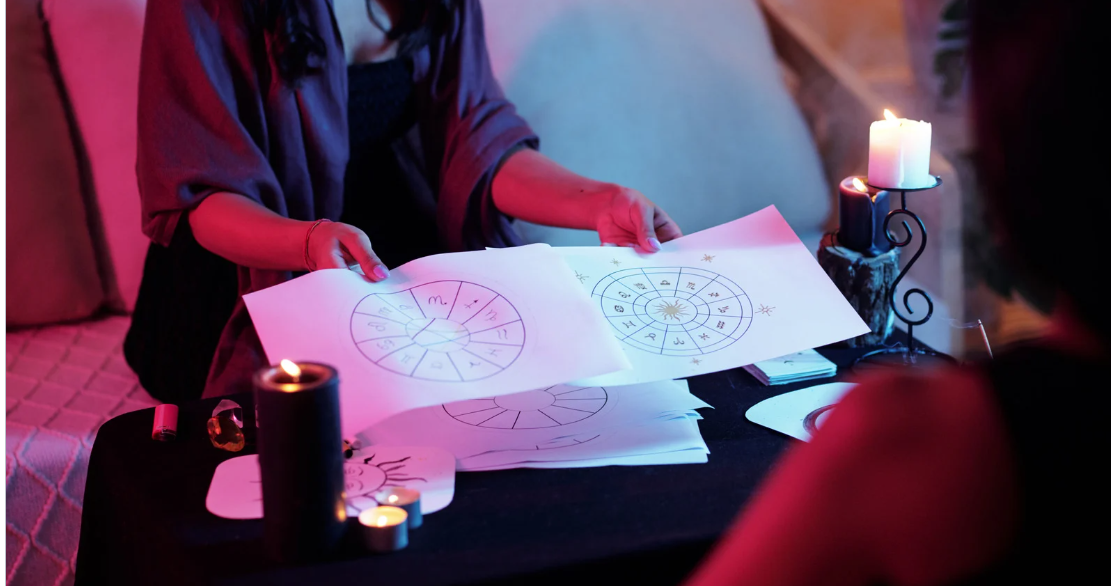
Astrology uses the apparent positions of celestial bodies and symbolic systems to interpret personality, timing, or life themes. Different schools use different calculations and rules. These systems have historical and cultural significance, but controlled scientific evidence does not establish astrology as a reliable way to predict individual events.
Vedic or Jyotisha Traditions
Jyotisha developed in South Asia and includes several lineages and techniques. Practitioners may interpret a birth chart using date, time, and location, planetary periods called dashas, houses, and divisional charts. Terms and practices vary, and simplified online descriptions can blur important distinctions. Treat interpretations as tradition-based reflection rather than verified destiny.
Jaimini Methods
Jaimini astrology refers to techniques associated with texts and commentarial traditions attributed to Jaimini. Some practitioners emphasize sign-based aspects, special indicators, and timing systems. It should not be described as automatically accurate or as a solution when birth information is missing; accuracy claims require evidence that these methods have not demonstrated.
Horary Astrology
Horary astrology interprets a chart for the time a question is asked rather than relying only on a natal chart. It can provide a structured way to explore a question, but it cannot verify another person’s private thoughts, diagnose illness, locate a missing person, or guarantee an outcome.
Palmistry
Palmistry interprets hand shape, lines, mounts, and other features through systems that vary by culture and practitioner. Hands can change through age, work, injury, and health, but palm lines have not been shown to encode a person’s fixed destiny. Use a reading as symbolic conversation, not as medical screening or proof of personality.
Numerology
Numerology assigns symbolic meanings to numbers derived from names, dates, or other information. Different systems may produce different results. Changing the spelling of a name has not been shown to change external events or guarantee compatibility. A number can be used as a journaling prompt, but it should not determine contracts, investments, treatment, or relationships.
Tarot and Other Card Readings
A standard modern tarot deck commonly contains 78 cards divided into 22 Major Arcana and 56 Minor Arcana, though decks and reading styles vary. Cards can help a person consider multiple interpretations or articulate a concern. They do not provide a tested mechanism for seeing future events.
A helpful reader uses conditional language, welcomes questions, and leaves decisions with the client. A harmful reader may claim certainty, create fear, or demand repeated payment to prevent a predicted disaster.
Feng Shui
Feng shui is a Chinese tradition concerned with the relationship between people and their environments. Schools differ in their use of direction, form, time, and symbolic correspondences. Rearranging a room may improve comfort or function, but claims that it guarantees health, wealth, or relationship outcomes go beyond reliable evidence.
Crystal Balls and Scrying
Scrying practices involve gazing into a reflective or translucent surface and interpreting images or impressions. Experiences may be shaped by expectation, imagination, pattern recognition, and the reader’s framework. They should not be presented as objective surveillance of future events.
Why Predictions Can Feel Accurate
Several ordinary processes can make a prediction feel striking:
- Broad statements: flexible wording can fit many people.
- Selective memory: hits are easier to remember than misses.
- Confirmation bias: people notice details that support an expectation.
- Feedback: a reader may adapt to verbal and nonverbal cues.
- Self-fulfilling effects: believing a prediction can change behavior.
- Probability: common events sometimes occur after a prediction by chance.
These possibilities do not require accusing every practitioner of deception. They simply explain why confidence should depend on documented accuracy rather than personal vividness alone.
How to Evaluate a Forecast or Reading
- Write the claim in specific, time-limited language before the outcome.
- Record every prediction, not only memorable successes.
- Separate information you supplied from information the reader generated.
- Define in advance what would count as correct or incorrect.
- Compare the result with chance, common outcomes, and non-spiritual explanations.
- Never risk safety or essential money to test a prediction.
For more detail, see how to assess whether phone readings are accurate and our guide to psychic phone readings.
Use Scenarios for Real-World Decisions
When the stakes are high, replace a single prediction with several scenarios. If you are considering a job change, for example, examine savings, demand for your skills, health coverage, and fallback options. If you are uncertain about a relationship, look at communication, consent, compatibility, and behavior rather than a destiny label such as soulmate.
Choose reversible steps when possible: gather another estimate, schedule a professional consultation, try a short pilot, or set a review date. Update your plan when evidence changes.
Safer Boundaries for Spiritual Guidance
Decide your time and spending limit before a reading. Do not share passwords, account numbers, or information that could be used for identity theft. Leave if a reader claims you are cursed, guarantees an outcome, asks you to keep secrets, pressures you to return, or tells you to ignore qualified care.
Afterward, pause before acting. Our article on what to do after a psychic reading offers a structured way to separate reflection from urgent decisions. A reading may feel useful without being literally predictive.
Frequently Asked Questions
Can anyone predict the future with certainty?
No. Future events depend on many interacting factors, chance, and choices. Reliable forecasts express uncertainty and can be revised; certainty should be treated as a warning sign.
Is astrology scientifically proven to predict events?
No. Astrology has cultural and personal significance for many people, but scientific evidence does not establish it as a reliable method for predicting an individual’s future.
Can tarot cards help with a decision?
They may help you explore feelings, alternatives, or questions. They cannot guarantee the result. Pair reflection with evidence, qualified advice, and a plan that protects your safety and resources.
How can I test a psychic prediction fairly?
Record a specific claim and deadline before the outcome, track misses as well as hits, define success in advance, and compare with chance and common outcomes. Do not take medical, legal, financial, or safety risks to run a test.